
G2 lists 200,000 software products right now. Two thousand categories. And AI is causing this to accelerate; 20,000 new AI products appeared in a single year, a 391% spike. Every software category is being flooded with new entrants that all sound the same.
An explosion of sameness.
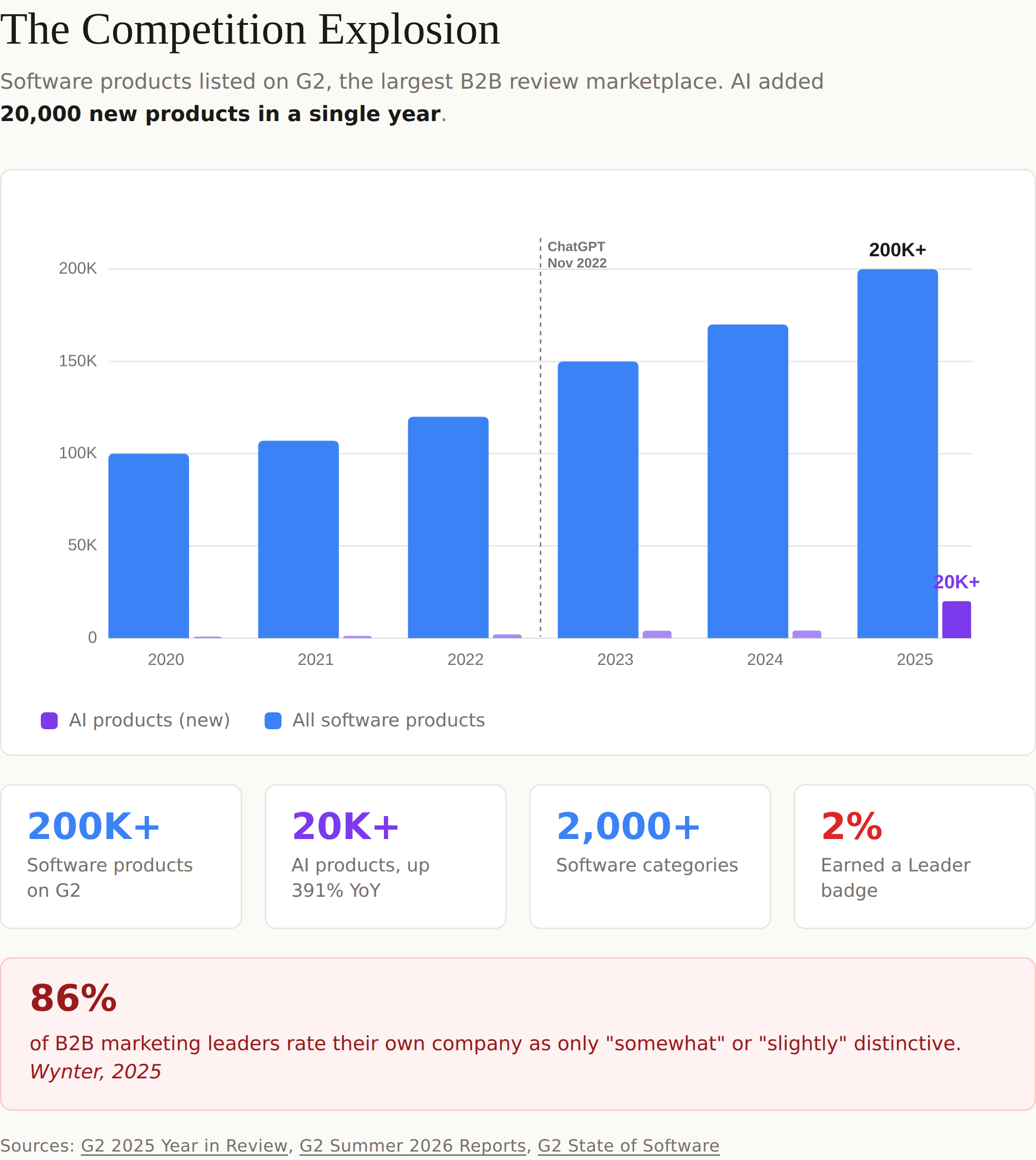
Wynter surveyed 100 B2B marketing leaders this year. 86% rated their own company as only “somewhat” or “slightly” distinctive. 6% said, “very distinctive.” It’s incredibly hard to sound different.
I’ve had so many conversations with founders and marketing leaders. They’re trapped in a positioning nightmare. What’s your positioning strategy when all products begin to look and sound the same? How do you position your product, deliberately defining why you’re different in a way that makes a specific market care?
This is one of the most critical parts of marketing today.
Perplexity didn’t try to out-search Google. They called themselves an “answer engine,” refused to show blue links, and never mentioned Google. $23B valuation in 30 months. Stripe repositioned payments to compete with PayPal by framing payments as a developer problem, made “7 lines of code” the entire pitch. They process over $1 trillion a year.
Positioning is HARD!
I’ve been quietly working on an entire marketing os. In this post, I want to share my positioning and web copy skills. It’s a mini system; it maps where you are, shows where you should be, and gives you the diagnostics to move.
Is it better than a world-class product marketer skilled at positioning and copy? No.
Is it better than what a lot of product marketers would produce? Is it incredibly helpful for teams and founders who don’t have a strong product marketer to work with? Yes.
→ Get the Positioning System on GitHub.
The Positioning Framework. What actually matters
Most of the marketing systems being pushed online have been created by Claude and Claude only. There isn’t anything unique about the skills within those systems when you dig in.
Some months ago, I found myself falling into the same trap. I built things with Claude but rarely checked its work. I rarely checked the context it was building for me, the skills, the plugins.
I’ve changed my approach to AI; I believe my domain expertise matters. I spend many, many hours working on a single skill.
The positioning skills are an example of that. I wanted to extrapolate what I felt truly matters for positioning. I wanted to map to some of the best advice from some of the best minds. But I didn’t just want it to be a dump of expert-led advice. I tested and iterated on what’s in that skill.
It features learnings from experts like April Dunford, Ries & Trout, Andy Raskin, Flint McGlaughlin, Anthony Pierri, Lenny Rachitsky, Emily Kramer, Elena Verna, Claire Suellentrop, and Bob Moesta. I distilled all that work into six principles:
Narrow your target ruthlessly. “Marketing teams” is millions of people. “Content marketers at B2B SaaS who publish weekly but can’t tell what’s working” is a target you can write for.
Start from the buyer’s reality, not your product. Lead with their problem, not your features.
Own one thing. Pick the single claim that matters most. Repeat it everywhere. Everything else is supporting evidence.
Differentiation must be concrete and defensible. Apply the competitor test: could your nearest competitor paste their name into this claim? If yes, it’s not a differentiator.
Positioning is cross-functional, not a marketing exercise. It shapes the homepage, the sales pitch, the pricing page, the ads.
Lead with a narrative about change. The shift in the world that makes your product urgent now.
I followed the same process for all my skills. The website copy skill I’m giving away comes from my experiences and learnings, paired with advice from some of the best copywriters throughout time. It includes things like using your customers’ actual words, not yours. Customers describe their problems better than any copywriter can.
These principles form the foundation of what I’m sharing in this post.
→ Get the Positioning System on GitHub.
1. Brand Context Template
Context matters so much more than skills. When building any AI system, no matter how large. Start by building a rich context set.
For positioning, we need to capture seven inputs: who uses it (jobs to be done), who buys it (if different), competitive alternatives (including “do nothing”), unique attributes that pass the competitor test, proof, and voice.
There’s also a key design choice that people don’t consider when doing positioning. For product-led growth companies, the user and the buyer are often different people. The person in the product daily and the person who approves the budget want to hear different things. You position for the user. But you need to layer in positioning for your buyer throughout certain parts of the buyer journey.
You can fill in this template in two ways. External AI research: scrape competitors, pull G2 reviews, search Reddit for how people describe the problem in their own words. Internal data: paste sales transcripts, support tickets, NPS verbatims.
For positioning, the single most important input is actual customer language. What they say, not what your team thinks they say.
Below is what’s included in the brand context template.
2. Positioning Skill
The positioning skill maps to the principles we talked about above.
It works against:
What’s changing in the world? (the urgency)
Who is this for? (narrow target)
What would they do without you? (the real alternatives, including doing nothing)
What do you have that they don’t? (with the competitor test applied to each claim)
Pick one thing. The hardest part. What’s the lead claim?
Choose your category. The frame that sets buyer expectations.
It supports two modes: first run (build positioning from scratch) and iteration (read your existing positioning, refine specific sections, show old vs. new delta). Another important tip when building AI systems is that the system should always feed learnings back into your context. In this case, you’ll keep updating your brand context after every product update, market shift, or competitor move.
The below is an example for the brand Wispr Flow. I recently fractured my elbow so have been using it a LOT. I used them as one of the brands to test my marketing os against.
→ The positioning skill and all six steps are in the repo. Grab it on GitHub.
3. Website Copy Skill
I’ve included one of my copy skills so you can translate positioning into website copy. The most common mistake i see people make when creating AI marketing systems is that they have one copy skill.
That just doesn’t work.
Website copy, creating a LinkedIn post, creating a YouTube transcript, creating a product launch video are all very different skills.
This skill is optimised to creating world-class website copy.
Five rules,
Use customers’ actual words, not yours.
Clarity before everything. If you have to choose between clever and clear, choose clear.
Lead with their problem, not your product.
Make every claim specific and provable. If you can’t prove it, cut it.
One page, one argument.
Here’s an example of what it did for WispFlow. The skill will create a HTML version of the home page. I think this is a great litmus test for positioning so you can review it.
→ The website copy skill includes the full expert-consensus ruleset. Get it on GitHub.
It will of course extract common AI patterns (what people call slop).
It’s a great bundle to have a co-worker help you iterate and brainstorm positioning for your company.
The full system
The full system is:
positioning-system/
├── context/
│ ├── brand-context.template.md ← Fill this in first
│ └── slop-patterns.md ← De-slop checklist for all copy output
├── product-marketing/
│ └── positioning.md ← Run this second
└── copy-team/
└── website/
└── website-copy.md ← Run this third
Each skill is written in conversational English, not written like an engineer.
I hope you enjoy.
Until Next Time,
Happy AI’fying
Kieran


