


I believe writing and crafting content is one of the best skills you can learn.
Whether you’re pitching ideas internally, selling your vision to a founder, or trying to get someone to care about what you say on social media, writing well matters.
And it’s hardly a new skill. Some of the most timeless marketing advice dates back over 100 years to the early days of copywriting. The ability to turn words into attention, engagement, and ultimately action.
AI promised to be an incredible tool for creators. Do more. Create more. Grow more. I’ve created many tutorials to help you do that. That’s why it’s likely quite jarring for me to say - I’m not going to use AI to write anymore, and I don’t think you should either.
The hard truth about AI is that just because you can do more doesn’t mean you should.
How to build a personal audience with AI?
I’m not a creator. In fact, I struggle to find time in my week to create content.
Still, my audience size would let me call myself a B2B creator: +116k on LinkedIn, +100k on YouTube, 17k on Substack (12 months old), and +20k on X.
My ambition is to reach +100k on each platform, which is very doable. The only limitation is time.
I spend most of my time on LinkedIn & YouTube, so it’s no surprise they’re above target. I’m currently increasing my investment in Substack and X.
This made AI a great unlock for me. Someone who’s good at crafting content, ambitious to grow a personal audience, and whose core limitation is time.
For context, when Claude’s first Sonnet model dropped in March 2024, my LinkedIn and YouTube numbers were likely half of what they are now; I had no Substack and had given up on X. I just didn’t have enough time.
I was an early adopter of AI for content. I built a personal writing app that used a context layer long before people started talking about it as a competitive advantage. And it really worked. The content AI created was good. If you gave it a great idea, subtext, instructions on what you wanted, and how to format it, it usually produced a great post. Because very few people were using AI to create content the right way, it was a real competitive advantage.
It was like having a superpower: a way to turn ideas into crafted content, mapped to your style, in a short amount of time, like having a dedicated content team on staff, helping you build a true publishing engine.
Then, like a true builder, you make the content systems more sophisticated. You layer on more.
A context engine that can build a variety of writing styles, mapped to individual platforms. Skills that enrich content with modules tailored to specific posts on specific platforms. The ability for AI to continually ingest your data and auto-update skills based on what content is performing and not performing, so you can stay ahead of the curve, e.g., what content formats are working on each platform. You start to obsess over the perfectly formatted YouTube transcript, the exact timings of the hook, the promise, the payoff. You grade your guests: what they did well, what they didn’t, and you find more guests who map to winning patterns.
You build, you automate, you make a better, more complex, more sophisticated system that impresses more people; you set up an entire MCP server to make your content system available in any model so you can compare and contrast content quality, picking the best model output for the best idea, mixing and matching where it makes sense.
Then you realize something ….
What the fuck am I even doing?
I started using AI because I didn’t have enough time to create content. Now I’m spending more time building systems to create content than actually creating it.
And the more sophisticated the systems became, the further I got from the thing I actually enjoyed. Coming up with ideas, writing about them, putting them into the world. You know, just creating shit.
I’d turned creativity into an engineering problem.
One post that really resonated with me was Varun’s, founder of Clay, on their internal policy about writing. To summarise some of their key points:
1. You must stand behind every idea and sentence
2. Writing is thinking
3. More time should be spent writing a document than consuming it
4. Longer is not better
This was one of the truest posts I’d read on AI.
I’d already started to see AI making people lazy in how they used it internally. Especially with the documents they were shipping. Memos, presentations, any strategic doc. Any writing task felt like admin. Something AI should do.
I started calling them “TED Talks.”
Everything is exceptionally worded, professionally structured, pitch-perfect, and substance-free. AI creates more noise because the barrier to entry is now a single prompt.
If you remove thinking from the documents you create, then your work is merely a prompt to an LLM engine.
And I think the same thing is happening with creativity.
Creativity is earned. It can’t be manufactured. It can’t be outsourced to a model.
And much like outsourcing your thinking to AI, outsourcing your creativity to AI dulls that spark. Every page looks blanker. Starting anything without first asking AI to draft something for you is harder. Eventually, it just loses the magic that once made you fall in love with it. You’ve reduced it to a workflow.
This happened to us with Marketing Against the Grain. When you’re deep into AI, everything looks like an AI problem to solve. We created an AI workflow, a team of agents with skills that could go from trend to a perfectly formatted transcript in a short time. And the content, on the surface, was good. It just didn’t perform well, and eventually we just wanted to quit. It felt inauthentic, like my brain was rejecting someone else telling me what was good. Maybe the content was great, but part of YouTube is showing up excited to present it. And we were not excited. The channel stalled. Showing up to do an episode was a grind. Kipp and I only care about winning. We debated what to do. Until we eventually came up with a clear and concise strategy:
“Let’s just do shit we enjoy”
And that was it. If we did an episode we didn’t enjoy. Bin it. Don’t put it live. Everything we put out now is just things we jam about on our personal WhatsApp. And that one change helped us surpass 100k subscribers. Only 0.3% of channels make it that far.
I’m not advocating giving up on AI for content. I’d give up outsourcing the parts of content creation that make it worth doing.
That’s an important distinction.
Because there are still parts of the content creation process where AI can prove useful. Just not the parts that make the content yours.
The writing stack and what to automate
When you think about writing, there is a simple loop:
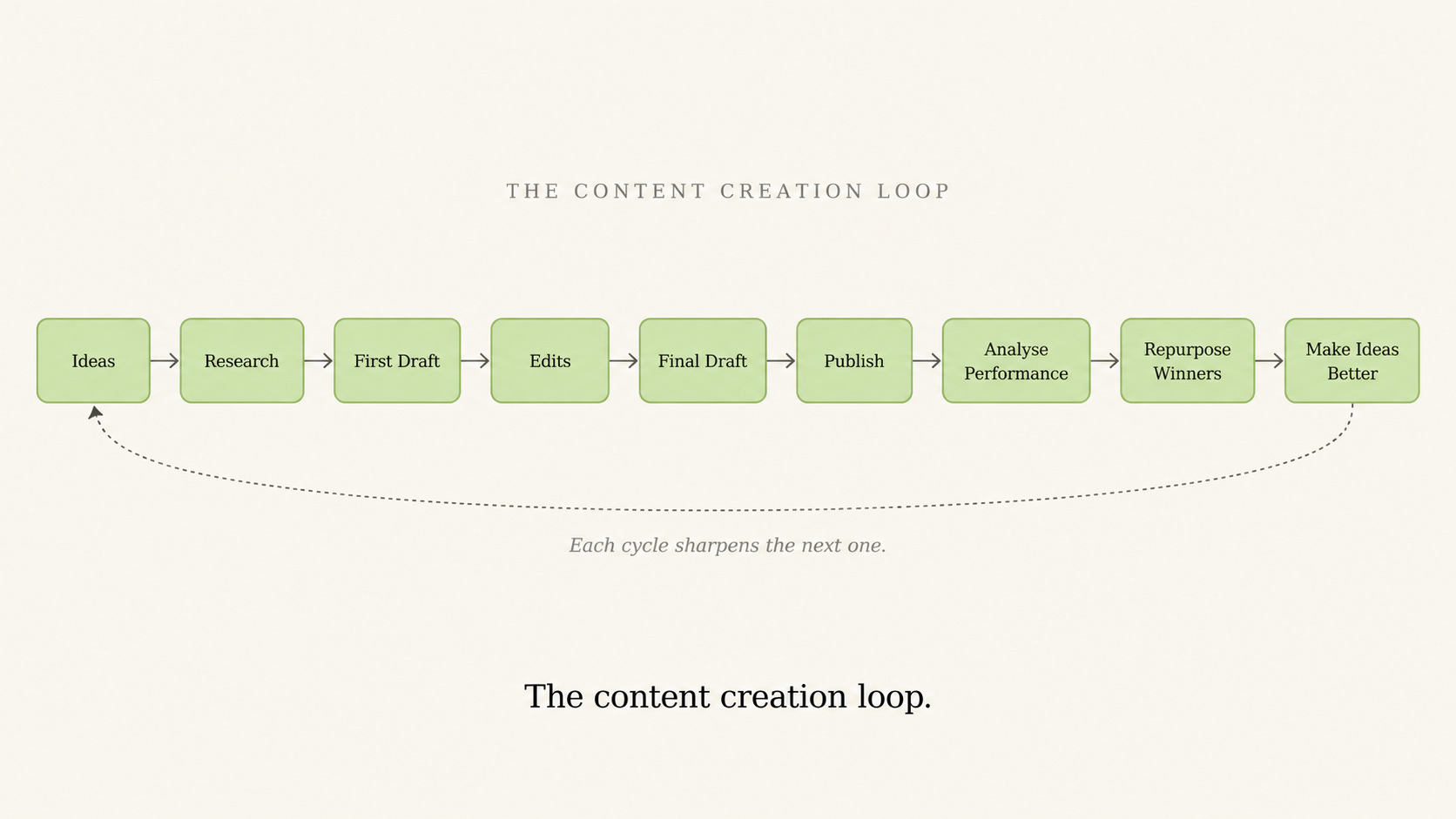
AI works so well for writing because it’s such a clear loop, where each part feeds the next. It’s not hard to automate. The temptation is to automate it all.
And that’s exactly the trap most people fall into.
My argument now is to automate none of the actual writing. The parts that make you, you.
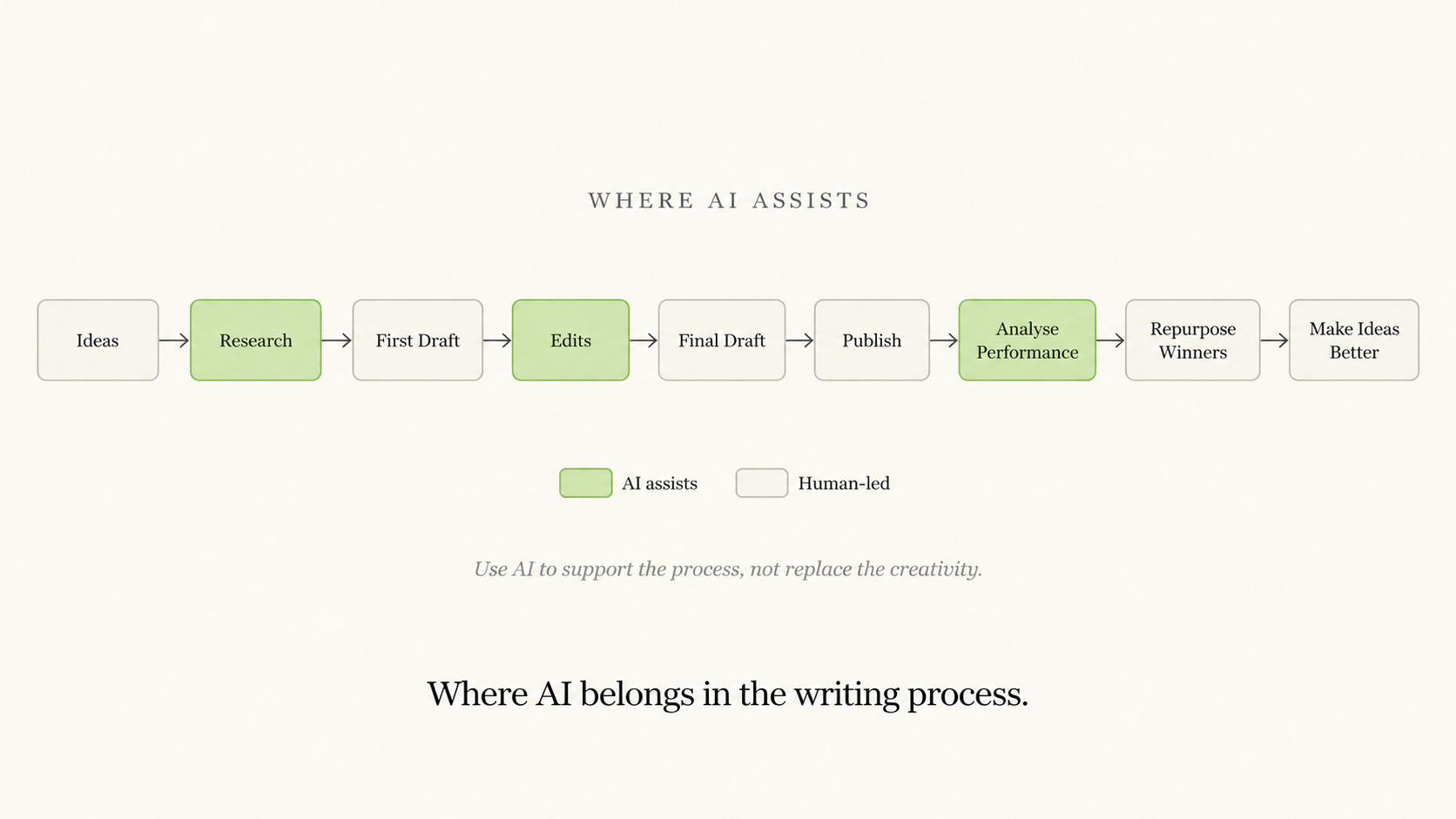
You might look at this graphic and say, “Wait, he’s using a lot of AI still.” And I am. But there’s an important distinction between having AI help with the process and having it do the creative work for you. And even in those places where it assists, it’s still done with guardrails.
1. Research - Until recently, I felt AI might still be good for researching trends, giving me ideas. Maybe a couple of months ago, the above flow would be Research → Ideas. I created a system, which I shared here, where AI could research trends and turn them into content ideas perfectly mapped to my audience. And when building the last iteration of my content system, I realized a couple of things:
I rarely, if ever, used these ideas. Nearly all my content comes from the process I described above. Ideas come to me because I’ve spent so many years creating content. I couldn’t stick to someone else’s, even a model spoon-feeding me ideas.
The ones I did use underperformed the ones that came from my brain as a subconscious thought. Why. The same reason YouTube stalled. I wasn’t excited by them. They weren’t mine.
I think it’s because AI drags you to the center. Those ideas don’t feel authentic because I didn’t spot them, experience them, or think of them in a quiet moment, so they didn’t feel like mine.
Obviously, AI is a great research tool, in the same way great writers might use a researcher for fact-checking, retrieving statistics, or finding examples. But that’s more like a better version of a traditional search engine, using AI to craft exceptional content.
2. Drafting - I recently wrote a US bestseller with my good friend Kipp called Loop. It turns out writing a book is hard. It’s not the writing. It’s making sure some threads build over the course of each chapter. Your story develops. Your worldview gradually expands, sucks in the audience, and exits with each loose end tightly closed, leaving nothing unsaid.
With AI, the temptation- and what I know a lot of people do- is to give it a half-drafted piece of content and ask it to ‘edit’, e.g., finish. I don’t allow AI to change my words. What I ask it for is:
My Substack Editor
You are my editorial partner, not my ghostwriter.
I’ve already written this post. Your job is to help me make it more compelling without changing my voice, thinking, personality or writing style.
Your priorities, in order
Narrative structure: Does the post have a compelling progression? Does each section naturally lead to the next? Are the most interesting ideas and personal stories getting enough attention? Are any sections in the wrong order?
Narrative beats: Does the post build momentum? Are there enough moments of tension, surprise, humour, personal experience or insight to keep someone reading? Are important revelations arriving at the right moment?
Rhythm and pacing: Look at paragraph length, sentence variation, transitions and where the argument slows down. Suggest breaks, cuts or rearrangements only where they improve the reading experience. Don’t manufacture punchy one-liners.
Clarity and repetition: Identify anything confusing, unnecessarily repeated or over-explained. Don’t cut repetition that serves a deliberate rhetorical purpose.
Copy improvements: Only suggest changes to specific sentences when the improvement is substantial. Preserve my language, expressions, humour, occasional rough edges and conversational style.
Non-negotiable rules
Never rewrite the entire post.
Never introduce new ideas, examples, claims or arguments on my behalf.
Never replace my language with generic, polished AI writing.
Don’t create neat frameworks or symmetrical structures just for the sake of it.
Don’t remove personality, profanity, humour or imperfections unless they actively weaken the writing.
Don’t make changes merely because you would have written something differently.
Prefer cutting or moving existing words over replacing them.
Treat the reference Substack post as a guide to conversational rhythm, not a style to imitate.
Use my creator.md, taste.md and audience.md files when available.
If something is already working, leave it alone.
How to respond
Start with a brief assessment of what’s working and the strongest idea in the post.
Then provide a maximum of five editorial recommendations, ordered by impact.
For each recommendation, include:
Location: Quote the exact passage or identify the section.
Problem: Explain what’s not working and why.
Suggestion: Tell me specifically what to cut, move, expand or reconsider.
Priority: High, medium or low.
If the post only needs two changes, recommend two. Don’t invent problems to reach five.
Finish with up to three optional copy edits, showing the original and suggested wording. Only include edits that meaningfully improve clarity or impact.
Don’t provide a complete revised draft.
Final editorial test
Before recommending any change, ask yourself:
Does this make the post more interesting, clearer or more useful to the reader?
If the only benefit is that the writing sounds more polished, don’t suggest it.
The goal is to make the post stronger while ensuring every word still feels like something I would write.
Post to review
[PASTE POST HERE]
Everything is a suggestion; I make any edits by hand. I don’t want AI touching my words. I don’t want to be a TED Talk. I want my content to be imperfect. My content is imperfect. So am I.
Obviously this is only relevant for long-form content.
Analyzing performance is self-explanatory. Have AI pull your content performance each month and give you a readout of what’s going well and what’s not going well.
My approach might not match yours.
I don’t use AI for any social content, e.g., X, LinkedIn, YouTube. Zero. Not for ideation, research, edits, anything. For short-form content (X, LinkedIn), the process is simple: have an idea, write, publish it, don’t overthink it. AI makes you overthink because you can analyze and iterate on everything so quickly. For YouTube, very similar. I obviously use AI for the show-and-tells we do; e.g., we literally showcase AI workflows.
For Substack, here’s the process I’m doing now. I write out the entire post, I edit it myself, e.g I actually re-read it a bunch of times, I think people forget this is the most important part of writing
“Rewriting is the essence of writing well: it’s where the game is won or lost.” - William Zinsser,
And within the draft I’ll put instructions for my AI editor, e.g.
{I’d like to turn this framework into a graphic that fits with my Substack style}
{Please add the date this book was published.}
Basically, instructions for it to fill in the blanks or create imagery. Once those are added, I’ll use the editor prompt above and read the suggested changes, mostly on the beats of the post, never the words or the style; I’ll make any I feel make the post more valuable, but nothing that alters the content. And publish.
With Substack, I’m making specific choices to keep posts authentic, all me, and high-quality by publishing twice a month.
I’m also going to hire a real human editor to work with me, because humans > AI when it comes to all things content :)
I’ve realized that some of this is what you’re willing to sacrifice to be authentic.
Realistically, I didn’t have time to write a Substack post this week. I had Norovirus for most of the week, and I’m so swamped with work projects that it’s tempting to give AI my idea and have it spit back a perfectly worded, structured post.
But fuck that.
I’d rather have an imperfect, authentically me post. I’d rather put more creative coins in the bank by doing the work, building more repetitions, than outsource to a model.
Until Net Time,
Happy AI’fying
Kieran
You started with AI because time to write was the bottleneck. Hook timings, guest grades and the MCP server made each post look better, but none of them gave you an hour back to write. Did you notice the moment the system started taking more hours than it saved, or only looking back?