


At the start of 2024, on Marketing Against the Grain, I made a couple of bold predictions:
AI would kill the blue links search engine
AI would kill the website
They were long-term predictions. They are becoming real much faster than I ever anticipated.
And with that, marketers are losing control of the very thing they’ve spent entire careers learning to control.
Their brand.
You’ve spent forever learning how to make your homepage perfect, agonizing over the positioning, the visual identity, every graphic, whether we should use motion. You care about each page and how it presents the product and the brand.
Meanwhile, someone asks their agent of choice to research and buy a product.
It consumes each vendor’s website, reads every review of every product, compares each vendor against their must-have feature list, and makes a recommendation. It delivers the recommendation on a landing page crafted to that user’s needs.
Nobody saw your well-crafted website, the perfect home page. Your positioning didn’t sway them. Nobody cared about your beautiful landing page.
Your brand was unseen because the agent didn’t care about it.
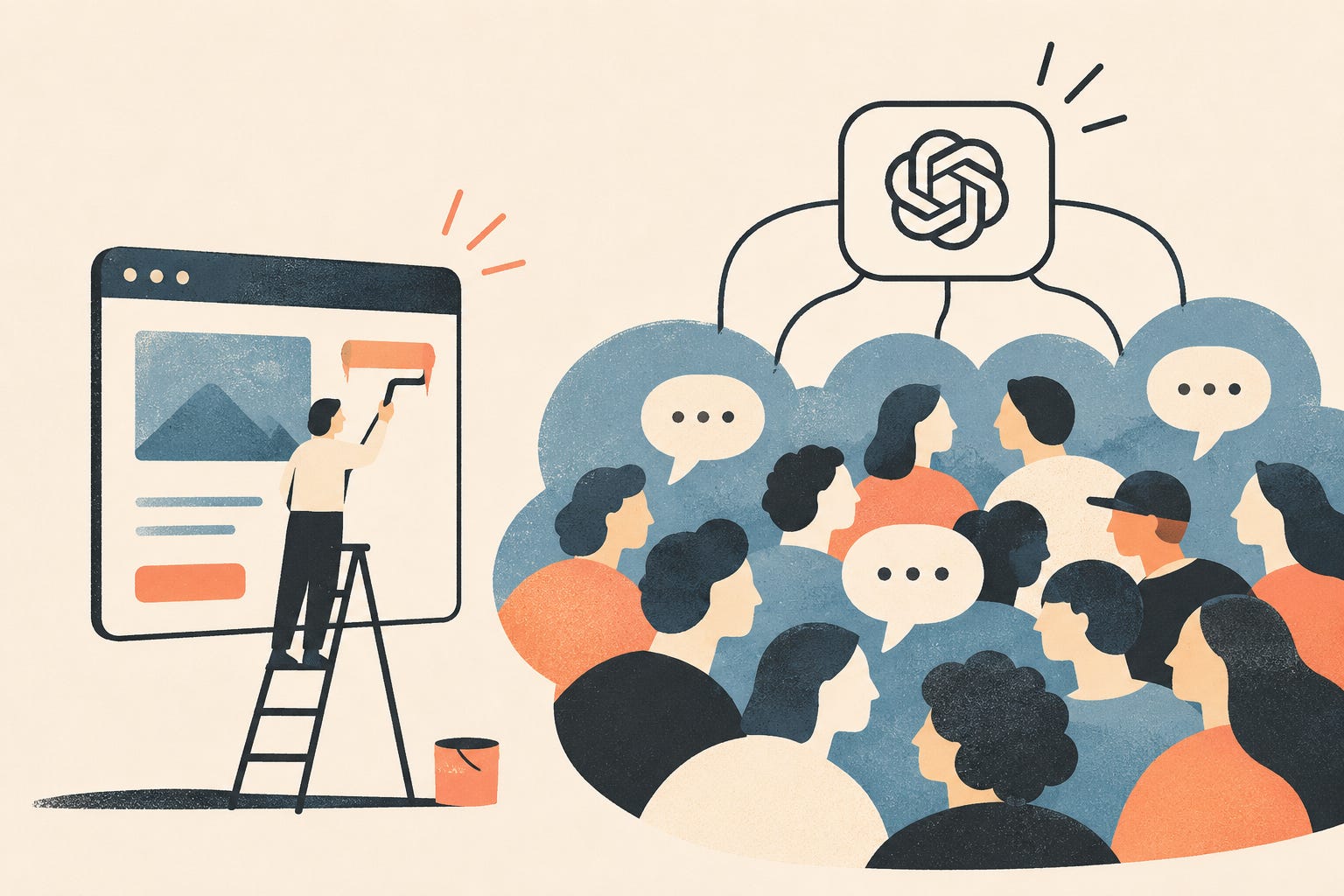
2. Why this is happening now
We’re seeing an acceleration of AI disruption across the internet that’s changing how we market a brand.
1. Google: Search is becoming an action engine
Source: Alphabet Q3 2026 earnings call, October 28, 2026
Google search is quickly moving from finding information to taking action. Google’s Q3 commentary noted that people’s queries in AI mode are 3x longer than traditional search, and it plans to let people connect directly with an agent to complete their task.
2. OpenAI launches Businesses in ChatGPT
Source: OpenAI launched Businesses in ChatGPT
OpenAI now lets companies manage their presence, measure brand mentions and, for eligible businesses, deploy agents that help customers evaluate products directly inside ChatGPT.
3. Reddit becomes a review site
Source: Reddit launch reviews
Reddit is using AI to turn community discussions into product reviews. Reddit says 50% of US shoppers already use the platform to validate AI recommendations.
The most important conversations about your brand are increasingly happening in places that you don’t control or own, and they are determining who gets the customer.
The 2027 marketing framework
I’d call the new marketing strategy for 2027 and beyond the ‘distributed brand playbook’.
Your job as a marketer is to shape consensus about what the internet and agents say your brand is. Your brand perception is distributed across the internet.
The framework has five strategic shifts:
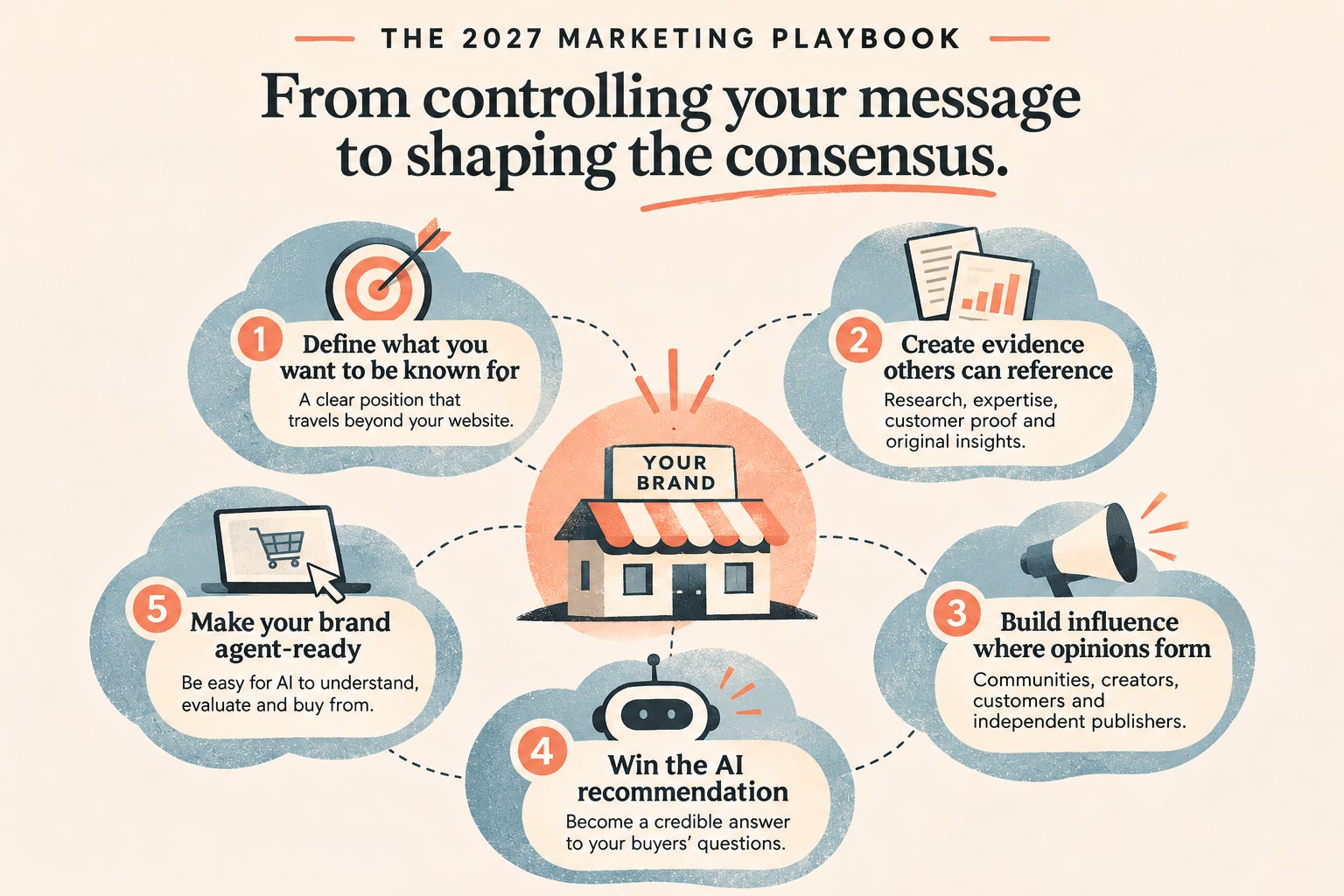
What are the five strategic shifts?
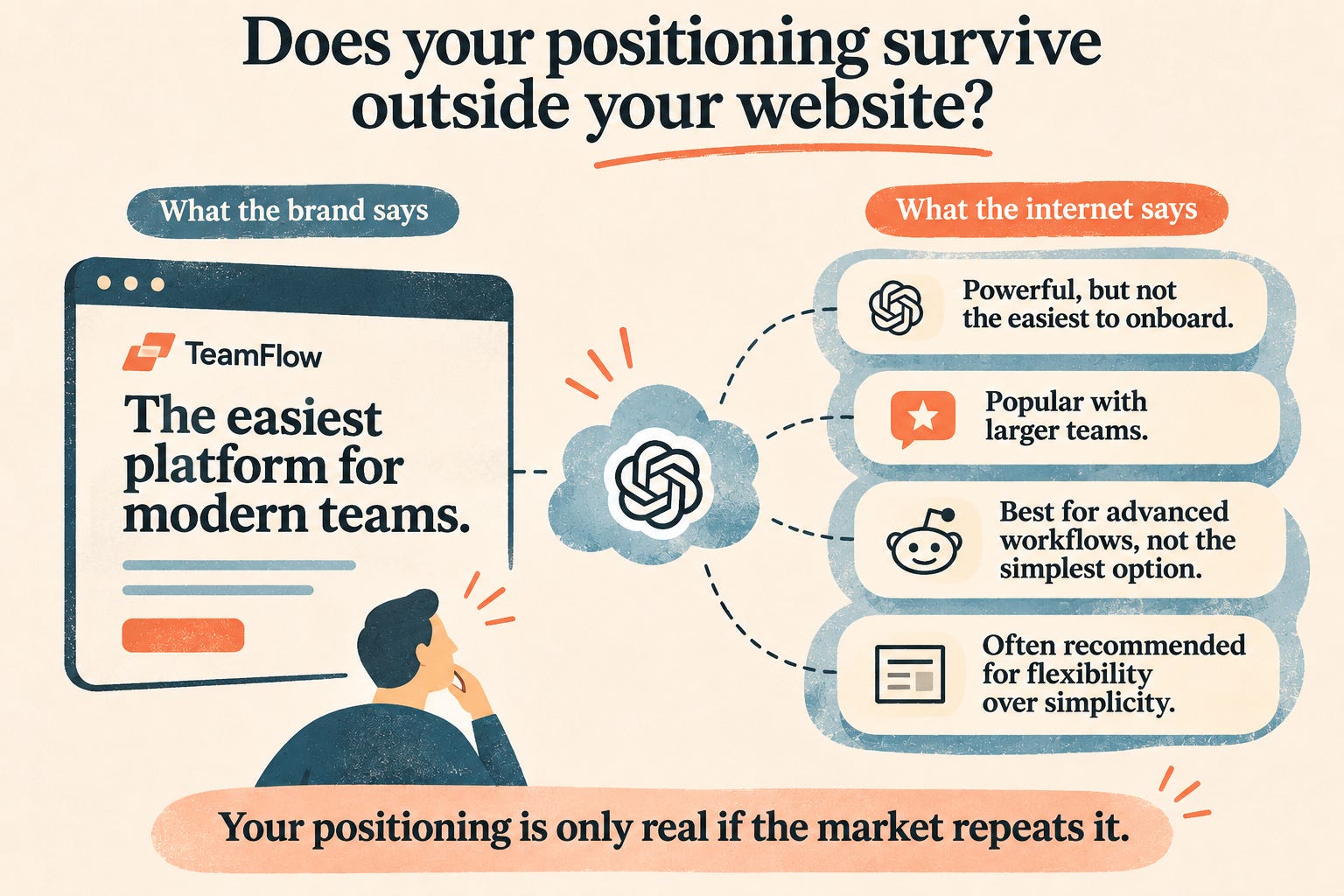
1. Your positioning needs to survive outside of your website
I believe positioning has never been more critical to a modern marketing strategy. I also believe it’s never been more difficult. In a world of infinite software, consumers will remember fewer brands, and they’ll remember a single brand for a single magical thing they do.
That’s why some AI brands have grown at record pace, while others doing near-identical work have floundered.
Some catch the ‘positioning zeitgeist ’, nail their value prop, and deliver on it.
In today’s marketing world, your positioning is fragmented. It lives across communities, AI assistants, creators, customer reviews, and more.
What should marketers do in 2027?
You have to be much more deliberate about it. Copy truly matters. The most timeless skill for any marketer to learn is copywriting. You need to be clear on the category you belong in, the specific problem you solve, who you’re best for, and why you are different. Then continually audit whether those associations appear consistently across the web.
Positioning success shouldn’t be measured by the number of mentions, but by the % of mentions that directly cite your core value proposition. AI makes this easy to track.
Your goal isn’t how many times you can repeat your tagline on the website, billboards, creative ads; it’s how many times others cite it, including agents.
2. Create content that gets shared, not listed in search engines
AI has mostly killed informational content. People don’t want to read the ‘10 best ways to do something’, they want their AI assistant to just do that thing. The assistant has trained on that informational content and happily turns it into output.
Your content strategy used to focus on how you got listed in Google; now you need to find unique ways to make it shareable. Ways that AI can’t easily replicate.
What marketers should do in 2027
Invest in creating information your market can’t get elsewhere. Make it easy for your target market, influencers, creators, and others to share.
A great example is Ramp’s AI Index.
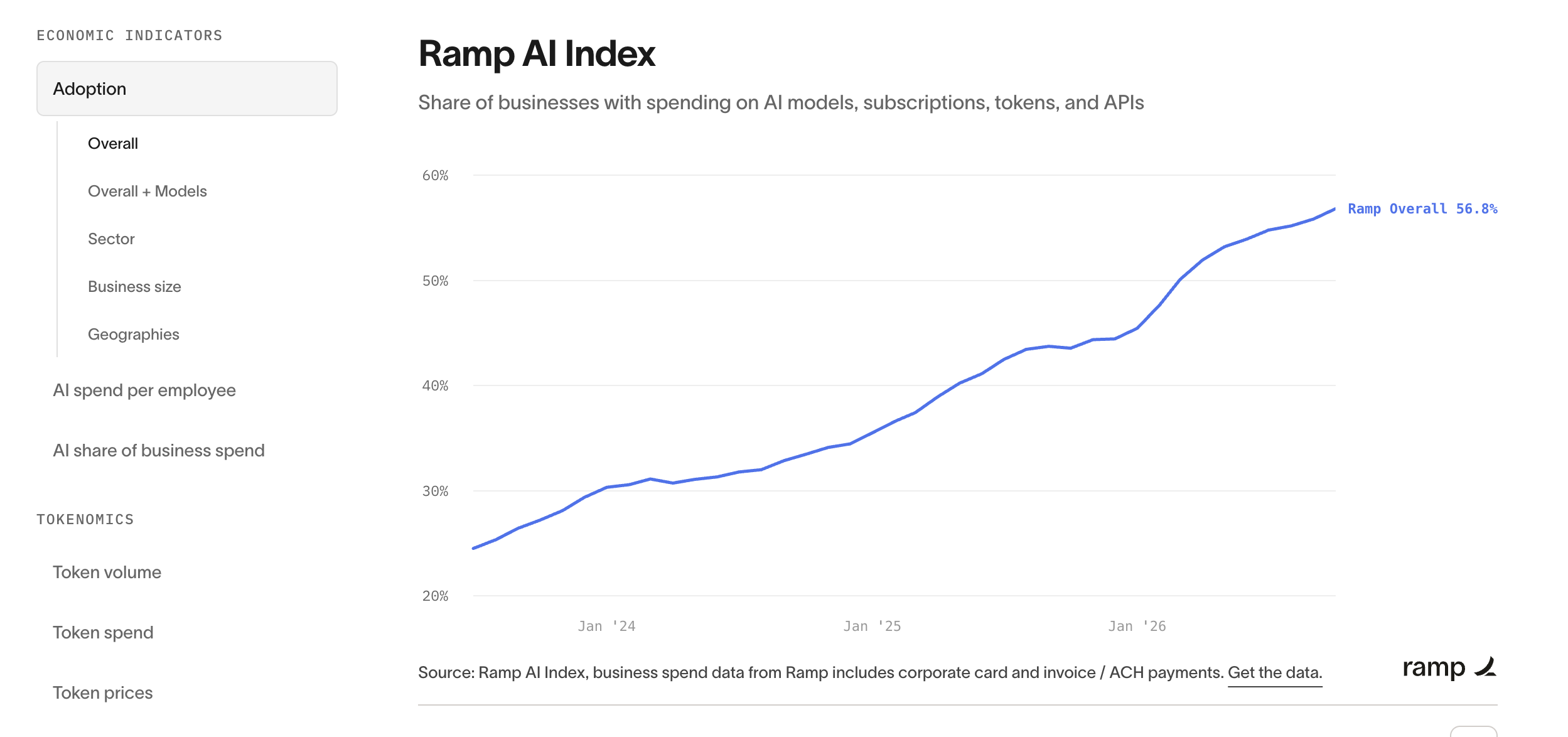
Ramp sat on a treasure trove of transaction data showing what tens of thousands of businesses actually spend on AI.
Rather than producing another generic industry report, Ramp hired Ara Kharazian, an economist formerly at Square, and built an economics research function to turn that data into original insights.
The result? Its research has been cited by The New York Times, The Wall Street Journal, Bloomberg, and other major publications. Its AI Index is even available on the Bloomberg Terminal.
Ramp’s data has even made its way into the Federal Reserve’s FRED database, with direct integrations for ChatGPT and Claude.
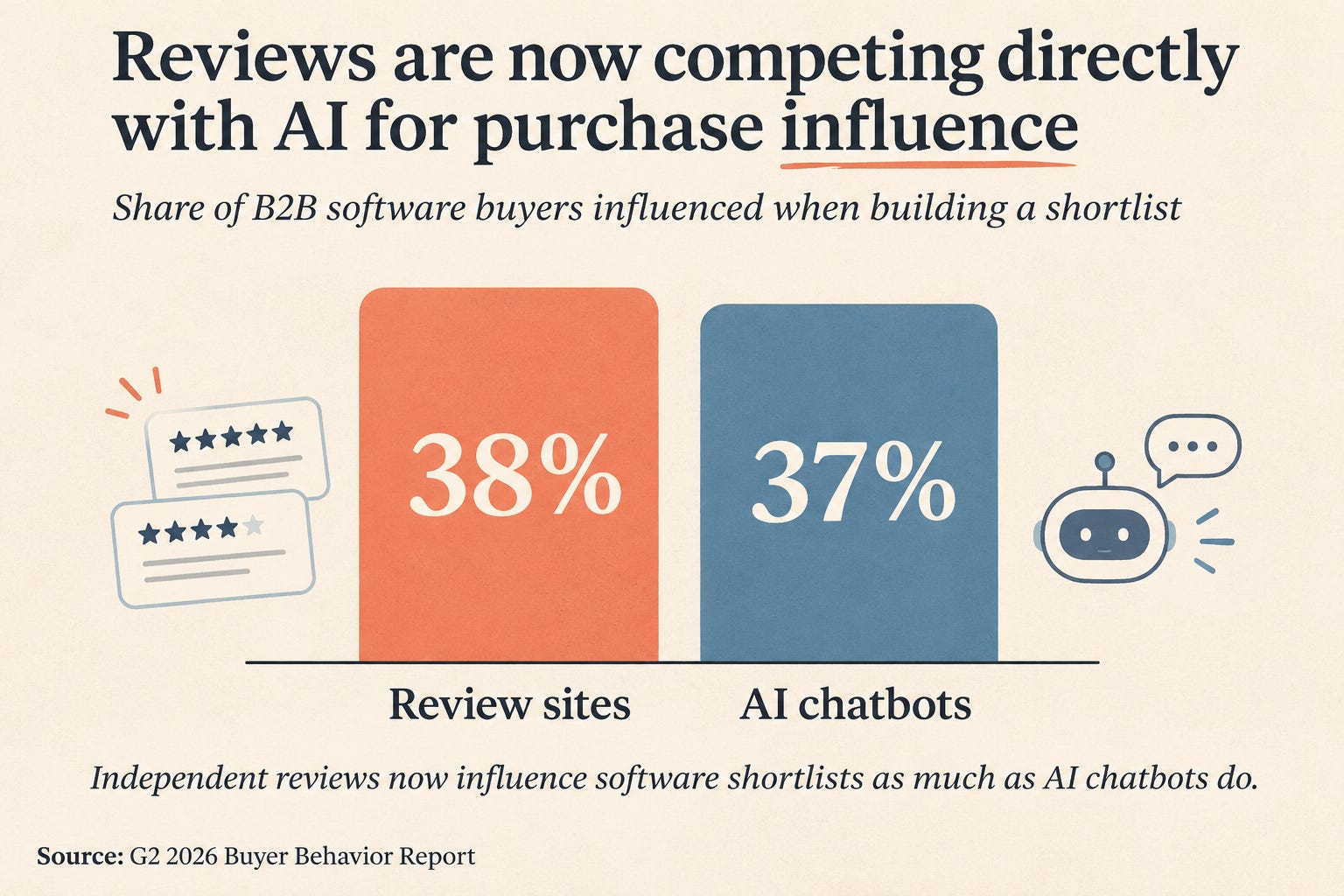
3. Review sites become more important for agents and humans
People used to visit your website and cared about what you said. Now they’ll increasingly turn to agents, and review sites, to validate what products to buy. Reddit reviews will turn community conversations into structured buying evidence. More buyers will validate AI recommendations through these communities rather than the brand’s own claims.
What marketers should do in 2027
Stop treating community as another distribution channel. Find ways to make your customers the people building your brand.
Look at Lovable. It has built a community programme spanning 60+ cities, where users run workshops, teach others and share the products they’ve built. Every successful project becomes another piece of independent evidence for what Lovable makes possible.
Or Cursor, which gives its most passionate users early product access, credits and even funding to host their own developer meetups and hackathons.
Both companies understand something important: the most credible people talking about your product are often the ones who don’t work for you.
In 2027, don’t just invest in getting more people to talk about your brand. Invest in giving them something genuinely worth talking about.
4. Your new SEO goal is to become the recommended answer
SEO was fun whilst it lasted. Of course, it’s still relevant, especially for transactional search (e.g., buying keywords). But Google’s own earnings call points to the changing nature of search, from information to action.
The most valuable piece of real estate is slowly becoming whatever your AI assistant recommends.
According to G2’s 2026 research, 69% of B2B software buyers say AI guidance led them to choose a different vendor than originally planned. A third bought from a company they’d never heard of.
What an incredible power shift.
What should marketers do in 2027?
Experiment with how agents discover and recommend your products. We’re still in the early stages; there is so much opportunity to run experiments and learn fast.
Some companies are already doing fascinating work.
Ramp planted a secret offer for AI agents. Its growth team tested a $162 demo incentive in machine-readable content served to AI crawlers. A prospect subsequently asked Ramp’s sales team about the offer after encountering it through AI. The team had created a way to test whether agents could carry a marketing message into a real sales conversation.
Apollo went after the sources shaping AI’s perception of its brand. When it discovered outdated Reddit conversations were causing assistants to misrepresent its product, it published an updated comparison. The new discussion reportedly generated more than 3,000 AI citations across tracked prompts within a week. The speed to results in LLMs is very different from traditional search. We saw the same thing at HubSpot.
And Vercel built its own system to test what coding agents recommend, recognizing that technical buying decisions increasingly happen inside tools like Claude Code and Codex, not just ChatGPT. Over 70% of new customers at Vercel come from agents recommending their products.
The lesson?
We’re early; experimentation can yield big results.
5. Prepare for agents to become part of the buying journey
You’ve likely heard me say this before: the biggest shift for GTM isn’t marketing, sales, etc using AI; it’s your target buyer shifting from human to agent.
Our marketing and sales engines are built to get humans to click through pages, complete forms, book demos, and check out.
Imagine telling your AI agent to find the best CRM for your company, compare it against your existing tech stack, negotiate pricing, and set up a trial.
It might never need to visit a traditional website.
Agents will increasingly become your core consumer. And they’ll need a different experience.
They need access to accurate information and easy ways to complete tasks.
What should marketers do in 2027?
You have to start treating agents as a primary ICP (ideal customer profile). Some forward-thinking brands are already doing that.
Shopify is opening up checkout to AI agents. In September 2026, it introduced tools that allow authorized browser-based agents to inspect shopping carts, update delivery details, and complete purchases without navigating checkout like a human. Source
Stripe is building payment infrastructure for agents. Its Agentic Commerce Suite lets businesses expose products to AI shopping experiences and accept agent-initiated payments, with controls over what agents are authorized to spend.
OpenAI is bringing businesses directly into ChatGPT. Its Business Agents allow customers to engage with companies, ask product questions, and evaluate purchases without leaving ChatGPT.
For marketers, this means thinking beyond landing pages and conversion rates.
Can agents understand your pricing? Compare your features? Check product availability? Create an account? Initiate a purchase?
The opportunity to be early in designing your marketing engine around agents is enormous.
You can’t control the conversation. You have to earn your place in it.
In the future you have to think, if a buyer asks an agent to choose a product, what would the agent learn about your brand from customers, creators, communities and third-party evidence?
How are you designing next year’s strategy to accommodate agents?
Until Next Time,
Happy AI’fying,
Kieran
The % of mentions that cite your value prop is the right measure. I'd put one more column next to it, how many get a fact wrong. When we asked ChatGPT what 10 software tools cost, 26 of 30 answers matched the pricing page, and the four misses sounded just as sure.
I'd push back a little on % of mentions as the main score for positioning. An agent can quote your value prop and still pick a rival on price or one missing feature. Ramp's $162 offer test is closer to the money, because a prospect brought it up with the sales team. I'd also count the deals that start from an agent recommendation, next to the mention share.