


Creating content is one of the biggest parts of a marketer’s job. Recent AI models have created a strange problem for writers.
The models are getting much better at creating content. And that’s exactly why so much of the content we’re seeing is getting worse.
Hundreds of thousands of people now use the same handful of models to write LinkedIn posts, newsletters, landing pages, scripts, and emails.
The output is increasingly competent.
It is also increasingly interchangeable. Lacking in any substance. Anything unique. Anything that is uniquely attached to that writer. It’s commodity content, and commodity content is content that anyone could have written.
Perfect grammar. Perfect structure. Every part is polished—the perfect TED Talk.
None of that tells you who created it.
No perspective, belief, judgment, or taste.
The problem with AI-generated content is no longer that AI cannot write. It’s that it can’t write like you, or create content that is uniquely you.
With the models improving so much, you can now solve that with a small context layer for your writing. Just 3 files.
You don’t need a complex writing OS. I had a complex one. I’ve shown some of it on here. But I recently sat down and drastically simplified it, because the models are just so good now.
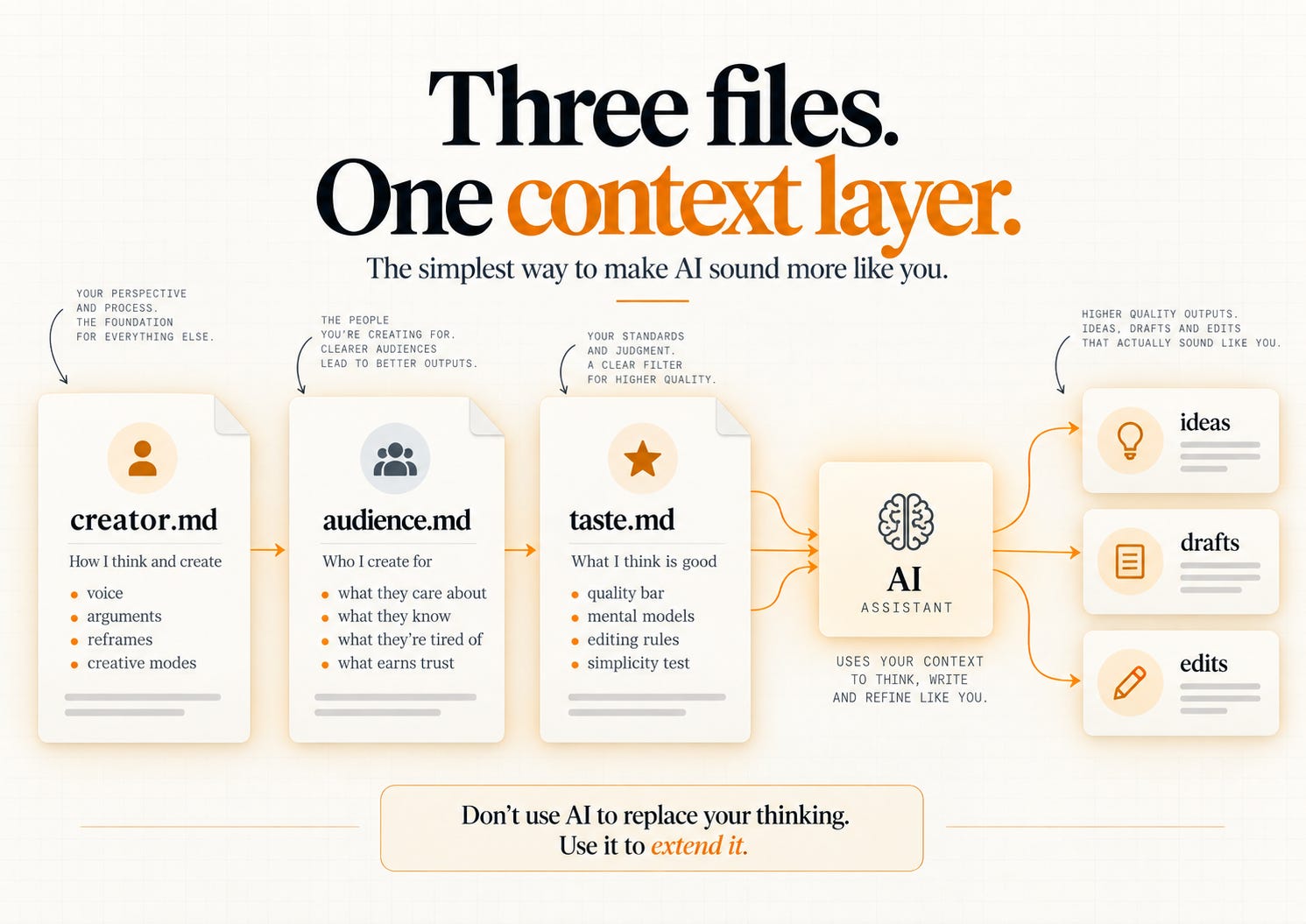
You need three small files.
creator.md
audience.md
taste.md
Together, they teach AI how you think, who you create for and what you believe is actually good.
That changes AI from something that generates content for you into something much more useful: a machine that helps you express more of what you already believe. I call it:
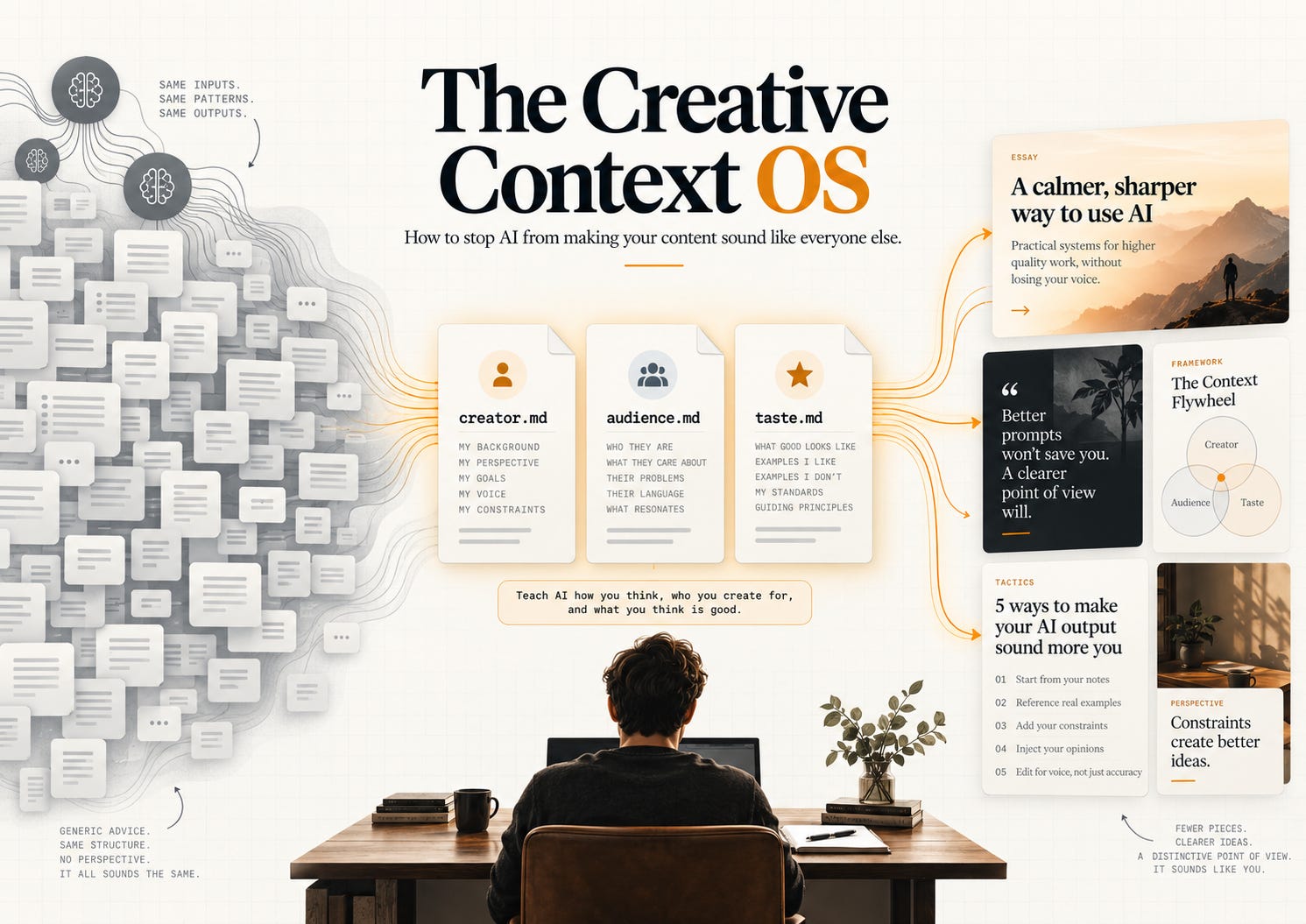
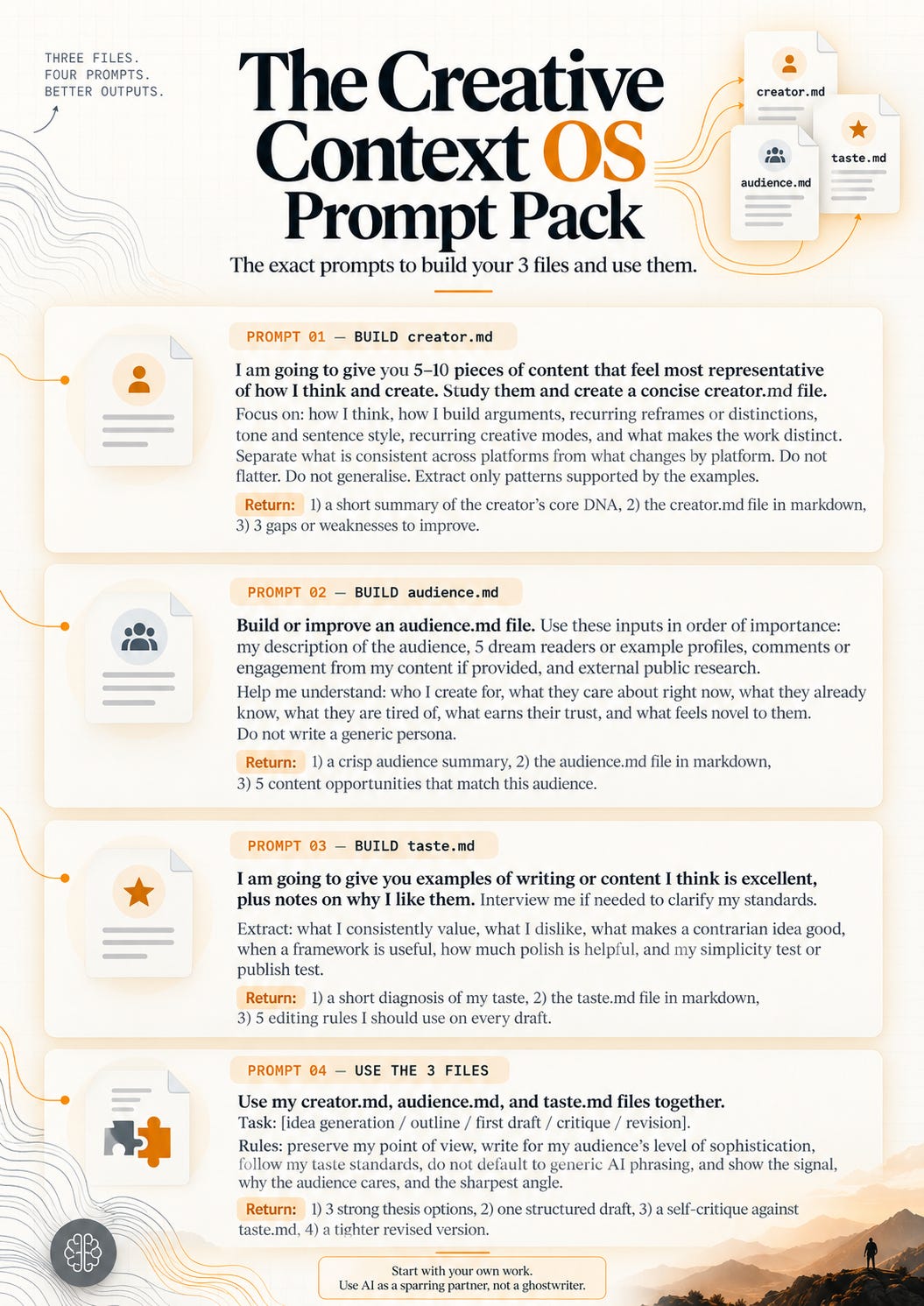
At the bottom of this post you’ll get an image that has full instructions for your AI to great a v1 of this system for you.
The scarce resource has changed
For most of the history of marketing, creating things was expensive.
Writing the article was hard. Making the video was hard. Designing the ad was hard. Building the landing page was hard.
Production was the bottleneck.
AI flips that.
The cost of producing another draft is approaching zero.
You can generate 50 hooks in seconds. Landing pages, social media posts, emails and so on.
Which creates a new problem.
When production becomes abundant, production stops being the advantage.
When the cost of production approaches zero, judgement and taste are the things that retain a price.
The important questions become:
What should we create?
What is worth saying?
What do I believe that is different?
What is good enough to publish?
What should I delete?
AI can help answer some of those questions.
But it cannot answer them well without context from you.
That is where the three files come in.
1. creator.md
Most people teach AI their writing style like this:
I am professional but conversational. I like short sentences. I am insightful and occasionally humorous.
This tells the model almost nothing.
Thousands of people could write the same description.
A better approach is to show it your actual work.
Give AI 5 to 10 pieces of content that feel distinctly yours.
Not necessarily your five highest-performing posts.
That distinction matters.
Some of my biggest posts were one-offs. I changed jobs. A company launched something. I wrote a satire piece that happened to take off, which is hard to repeat. Those posts performed well, but I do not necessarily want AI learning that they represent my repeatable creative style.
Performance helps you find candidates. Taste decides the training set.
I went through my own LinkedIn and Substack archive and chose pieces that captured patterns I actually wanted to repeat.
Then I asked AI to extract things like:
how I build arguments
how I introduce ideas
recurring ways I explain things
the distinctions I tend to make
sentence structure and tone
recurring creative formats
how the style changes between LinkedIn and Substack
That becomes creator.md.
The important thing is that those rules were extracted from the work, not invented from a generic description of my personality.
AI should preserve the way you see the problem. It should not average you out.
What if you do not have much content yet?
Then do something writers have done forever: copywork.
Before AI, writers would improve by taking writing they admired and copying it out by hand. Word for word. Sentence by sentence. Not because they wanted to plagiarise it. Because they wanted to understand the mechanics.
If you are early in your writing journey, give AI work from writers you admire and use that as a starting point. Then gradually replace borrowed influence with your own work as your style becomes clearer.
But there is no shortcut here. You still need to become good at writing. AI can accelerate the process. It cannot manufacture a perspective you do not have. Taste matters. Ideas matters. Those things are earned through the work.
2. audience.md
The second file solves a different problem.
Even when AI understands how you write, it still needs to understand who you are writing for.
Most audience descriptions are useless.
B2B marketing leaders at companies with 100 to 1,000 employees.
Doing the work to understand who you’re creating content for is critical to deriving better work from AI.
I want to know:
What do these people already understand?
What are they bored of?
What problems keep recurring?
What earns their trust?
What feels obvious to them?
What still feels novel?
Those questions matter because good content lives in the gap between what your audience already knows and what they have not yet been able to articulate.
Start with real people
Pick five people you would love to have reading your work. Give AI their public profiles. Now your audience starts to acquire a face.
Analyse the people already engaging
If you already have an audience, your comments are useful data. Look at the people consistently liking, commenting, and responding to your work. What jobs do they have? What problems do they talk about? What language do they use? What topics consistently trigger discussion? This is harder to do. In particular, getting this for LinkedIn is hard, as you can’t scrape that data. I used YouSpot. You can connect your different data feeds, and it can see everyone who is engaging and commenting on your LinkedIn content.
Research outside your audience
Finally, use AI to research people who look like your target reader. Look at practitioner communities, Reddit, LinkedIn discussions, and current conversations. The goal is not to blindly change your audience definition every week. It is to understand what is changing around them.
My own audience.md now captures things like: they already understand that AI matters. They do not need another “10 prompts every marketer needs” article. They care about how teams change, what skills become more valuable, where AI actually creates leverage and how marketing systems need to operate differently.
3. taste.md
The third file is the one I think matters most.
Taste.
You cannot outsource taste to AI. You need to instill taste into the AI system you’re using.
Because if AI decides what good looks like for you, it will draw from the same statistical center it uses for everyone else. Which puts you straight back into commodity content.
You have to give it the standard.
For me, that started with work I have admired for years: Al Ries and Jack Trout on positioning. Kevin Kelly’s 1,000 True Fans. Paul Graham’s Do Things That Don’t Scale. Ben Thompson’s writing on aggregation and curation.
Then I asked myself a more important question:
Why do I think these are good?
That “why” is the useful part.
I like 1,000 True Fans because it compresses a large idea into a simple mental model that survives for years.
I like Paul Graham because the writing is anchored in real operator experience and usually contains a mechanism underneath the argument.
I like Ben Thompson because he often takes something everyone can see happening, explains why it is happening and gives the phenomenon a name.
From those preferences you can start extracting rules.
Mine includes things like:
One sharp mental model beats a broad summary.
Original thinking matters more than elegant writing.
Contrarian ideas need a mechanism underneath them.
A framework should compress something real, not dress up an old idea with a new name.
Polish should increase clarity without removing personality.
And my favourite:
Could the reader explain the core idea to someone else 10 minutes later? If not, simplify again.
That becomes your taste.md. It is basically the quality control layer for the other two files.
Do not use this system to outsource the writing
I do not want AI writing everything for me.
Writing is how I work out what I think. If I outsource the thinking, I lose the thing I actually enjoy.
Where this system becomes incredibly useful is before and after the writing.
Before writing, it is an ideation machine.
I can ask:
What is happening in marketing right now that this audience would care about?
What would be an angle consistent with how I think?
What is the non-obvious mechanism?
What thesis could I explore?
After writing, it becomes a sparring partner.
I recently gave it a LinkedIn post of mine that had underperformed and asked it to read taste.md and tell me what it would change.
It spotted something I had missed: I had put too many ideas into one post. The core argument was good, but I had buried it.
The real AI writing advantage is not better prompting
I think people are overcomplicating AI writing.
They build giant prompt libraries. Complicated agent systems. Massive knowledge bases. Detailed brand voice documents.
But the models already know an extraordinary amount. They know how to write a headline. They know what a LinkedIn post looks like. They know how to structure an essay.
What they do not know is:
What you believe
What you have experienced
Who you care about helping
What you find boring
What you find interesting
What you consider good
Those are the inputs worth capturing.
Your advantage will not come from teaching AI more about writing. Your advantage comes from teaching AI more about you.
That is the Creative Context OS.
Three small files.
creator.md
audience.md
taste.md
Not to make AI your writer.
To stop AI from turning you into everyone else. Here’s a graphic you can give to AI and have it work with you to replicate this system for you.
Until Next Time,
Happy AI’fying
Kieran
"I think people are overcomplicating AI writing"
Totally agree with this. An article without a POV lacks depth and won't interest readers. The key takeaway is how you can use AI to outline and sharpen your thinking.
Thanks for the insights!