


After “Is the CMO role dying?”, the number one question I get asked most is what happens to the marketing team. How drastically will it change? And is it going to shrink in size?
In May, I published a first draft of an answer: how to rebuild your marketing team for the agentic age. It consisted of four layers. Context, Execution, Orchestration, Leadership. At the time, I said it was a work in progress.
This post is the evolution. I’ve talked to a lot of other AI-native leaders about what they’re seeing happen with the traditional marketing team. I’ve gone from that original model to a set of beliefs. These are 3 principles I think every future marketing team gets built on, and something you can use to start on each one this week.
Here’s what’s happening today: every founder wants marketing to do more, with less. Gartner’s 2026 CMO survey says 39% of CMOs plan to cut labor and agency costs. Boards across tech see AI and ask the founder/CEO: why does marketing still need the same headcount?
Gartner’s 2026 CMO survey says 39% of CMOs plan to cut labor and agency costs. Boards see AI and ask why marketing still needs the same headcount.
The same survey shows companies are spending more on marketing headcount, from 21.9% to 24.5% of the marketing budget. What’s interesting is Martech, e.g., actual tools, fell to 19.4%, a five-year low.
Then look at who’s winning. Emily Kramer analysed 100 of the fastest-growing B2B companies. 87 have open marketing roles. 507 roles in total. Every company that has raised over $500M is hiring marketers. Marketing holds steady at about 4% of headcount.
So, the narrative is marketing teams should be shrinking, but the best companies are hiring. The reality is the team is changing shape, and most of the debate online is about size.
Here’s the shape I believe in.
Principle 1: The 0-1 marketer
For forever we’ve built marketing teams out of specialists. A plethora of people with a specific domain expertise. A paid person, an SEO person, a PMM, a brand person. It’s been that way because humans can only hold so much context. That limits how much action they can take. It’s constrained by context.
Today, I’m seeing super generalists, powered by their own AI system, collapse all that expertise into an AI-pilled process. They can take an idea from nothing to shipped v1: the research, the positioning, the page, the campaign, the data analysis, all on their own. No handoffs. They’re a generalist, and what makes that possible is the system they work inside.
Every great personal AI system has 4 core parts. I’ve explained these in previous posts. Context is what you know: your market, your customer, your voice, what’s worked. Connections are the tools and data the system can reach. Skills are your playbooks, written down so an agent can run them. Artifacts are what ships.
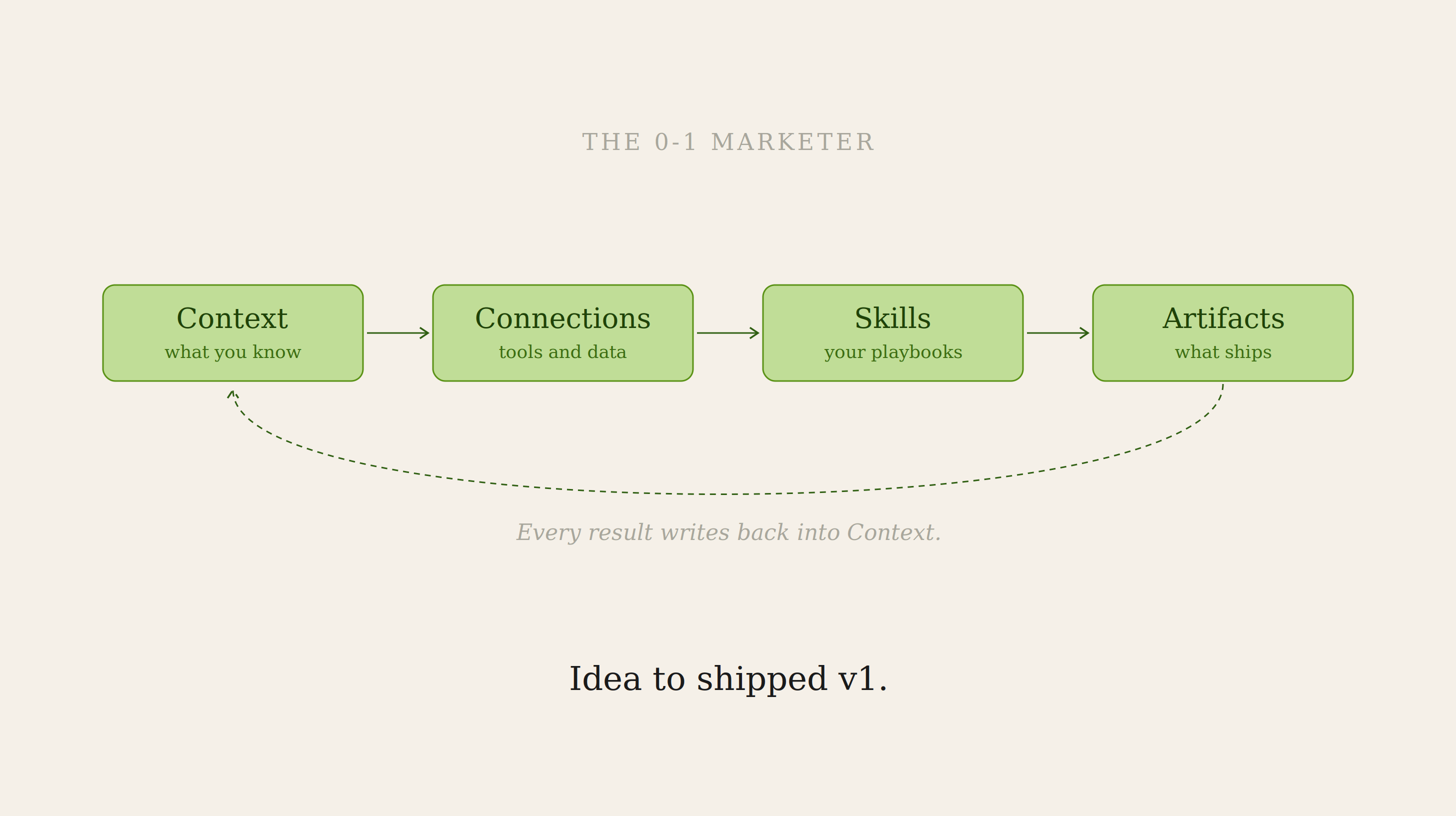
The critical thing in an AI system is the arrow back. The results write into Context, so the system gets smarter every time you ship. Back in May, I called this a loop. Today, loops are a common part of how we speak about AI.
We already see this role live in the market. Ramp has an “Agentic Operator, Growth Marketing” role. Cursor is hiring a “Marketing Systems Lead”. 84% of marketing job descriptions now mention AI. This is principle one on the changing shape of marketing teams.
Here is your homework. Unlike what most people are giving you, there is required work from you. AI is making people lazy. But, the best outcomes are still derived from your work.
Your takeaway: build your v1. Paste this into Claude:
You are helping me design v1 of my personal AI marketing system.
It has 4 parts: Context (what I know), Connections (the tools and
data I can reach), Skills (repeatable playbooks), Artifacts (what ships).

Interview me one question at a time. Ask about:
1. My role, company, and the outcome I'm accountable for
2. The 3 jobs I repeat most often
3. The tools and data sources I use each week
4. The best work I've shipped in the last year, and why it was good

Then give me a one-page system map:
- Context: the 3 to 5 files I should write first, one line on each
- Connections: the 2 tools to connect first, and what each adds
- Skills: the first 3 skills to build, in order, with input and output
- Artifacts: what each skill produces and where it ships
- The loop: which results get written back into Context

Keep it to what I can build in 2 weeks. Flag anything that needs
my judgment, not the model's.
Principle 2: Work in pods
Why do our existing org charts look the way they do?
The first org chart was drawn in 1855 to run a railway.
Daniel McCallum had just taken over the New York and Erie, nearly 500 miles of track and one of the longest systems in the world. A new technology, the telegraph, was flooding him with reports of delays and accidents. He had plenty of information. What he didn’t have was anyone clearly responsible for acting on it. So he drew a chart of who answers to whom.
It was shaped like a tree. The tree was built to move information around the organization. We’ve kept hold of that structure much longer than we should have, especially in marketing.
Every marketing team I’ve worked in has been some version of it. A leader at the top, channel owners underneath, specialists under them. Work travels up one branch, across, and down another.
That’s no longer how things work.
In an AI-native team, information flows through shared context in seconds. So the shape of the marketing team can change.
If one marketer can take an idea from 0 to 1, the team around them starts to look like a product team. Product and engineering worked this out years ago. Small teams. Each one owns an outcome. They ship every week, learn what worked/what didn’t, and go again.
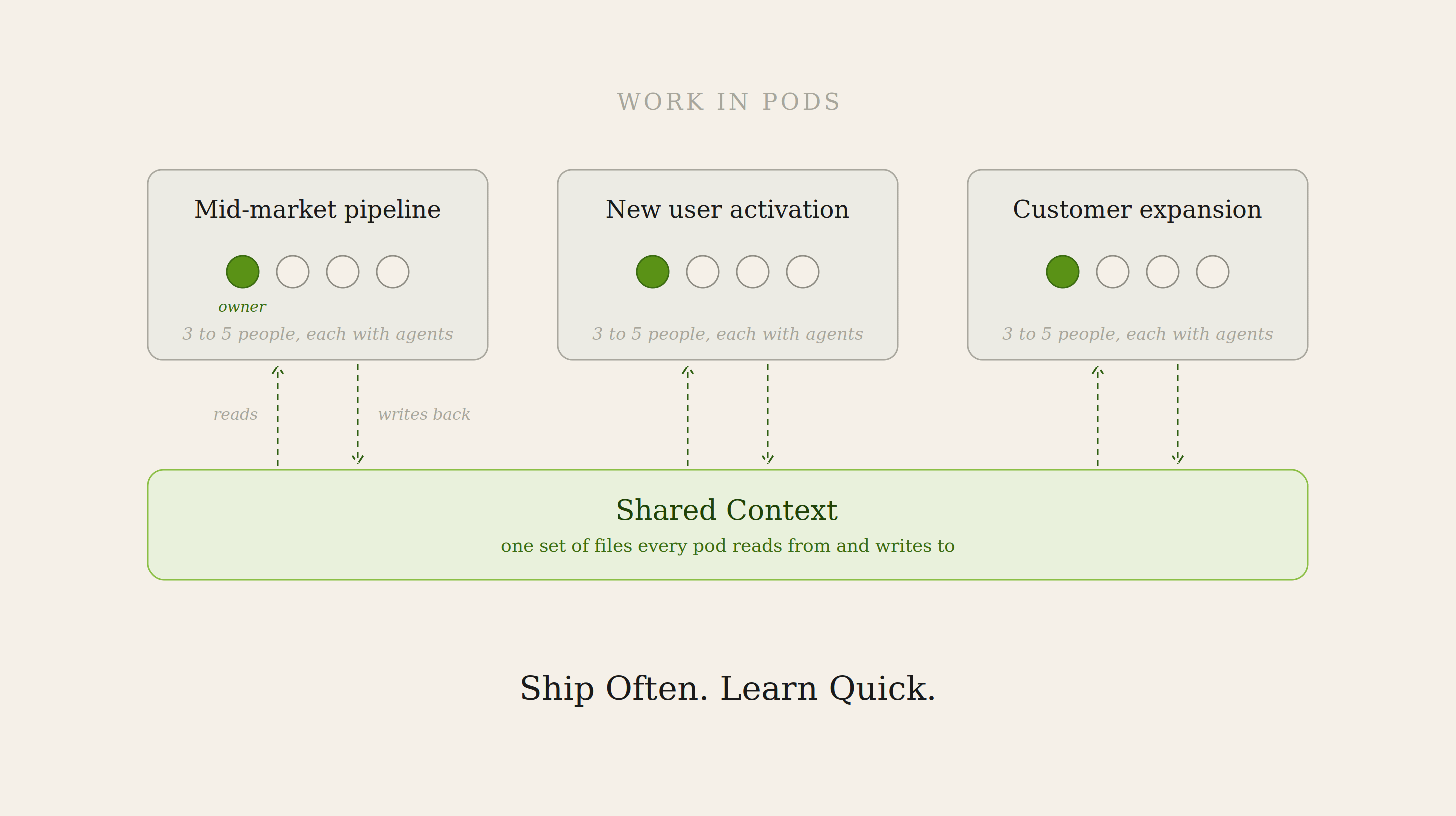
Your takeaway: the Pod v1 charter. Don’t reorganise the department. Run 1 pod for 6 weeks, on 5 rules.
One outcome. Give the pod a result to own, like grow pipeline by x%.
One named owner. They make the calls and carry the number. This is the part most teams struggle with. The DRI has to be able to give people in the pod real orders, real direction.
Super generalists. Pods consistent of 0-1 marketers and marketers with real depth of marketing craft (see principle 3).
One shared Context. The pod reads from and writes to the same files. This is what replaces the branches of the tree.
Ship and review weekly. Demo what went live. Write what you learned back into Context.
Principle 3: Depth of marketing craft
The first two principles can sound like an argument for a team of generalists. This third one is the one I feel most strongly about, and I likely undersold it in my original post.
Depth of marketing craft will matter more than ever.
That seems counter to the principles above. But all marketing teams will have 0-1 marketers, powered by AI systems. The core structure will be pods vs. trees. But the depth of marketing craft will matter more than ever. And I want to show you how those things sit together.
Take product marketing.
A 0-1 marketer with a good system can now cover a surprising amount of the PMM job. They can build a launch skill that turns a product brief into the messaging doc, the launch plan, the enablement deck and the release notes. They can run a skill that reads every customer call and pulls out the words buyers use. They can keep competitor battlecards current without anyone asking. They can get a first draft of positioning on the page in an afternoon. Idea to shipped v1, across most of the function.
That work used to eat a PMM’s week. There is so much they had to do.
But some parts of PMM have been drastically elevated in importance. The positioning that makes a buyer stop scrolling. The tier 1 launch the whole company rallies around, and the market takes notice of. The story that gets repeated by your ideal customer. The first draft gets you to good. Getting from good to great takes someone who has spent years learning what great looks like in that one discipline. They have the taste and judgment necessary to excel in those critical aspects of the role.
The system handles the volume, which hands the expert their time back. A great PMM used to spend most of the week producing. Now they get to spend it on the part only they can do.
And it runs the other way too. Everything the expert knows goes back into the system. Their positioning becomes Context. Their launch playbook becomes a Skill. Their eye for a weak headline becomes the bar every Artifact has to clear. The next first draft starts from a higher place, for everyone in the pod.
This is why the pod charter asks for people with different spikes. Everyone in the pod is a 0-1 marketer. Each one is also the person the pod turns to for depth in one craft.
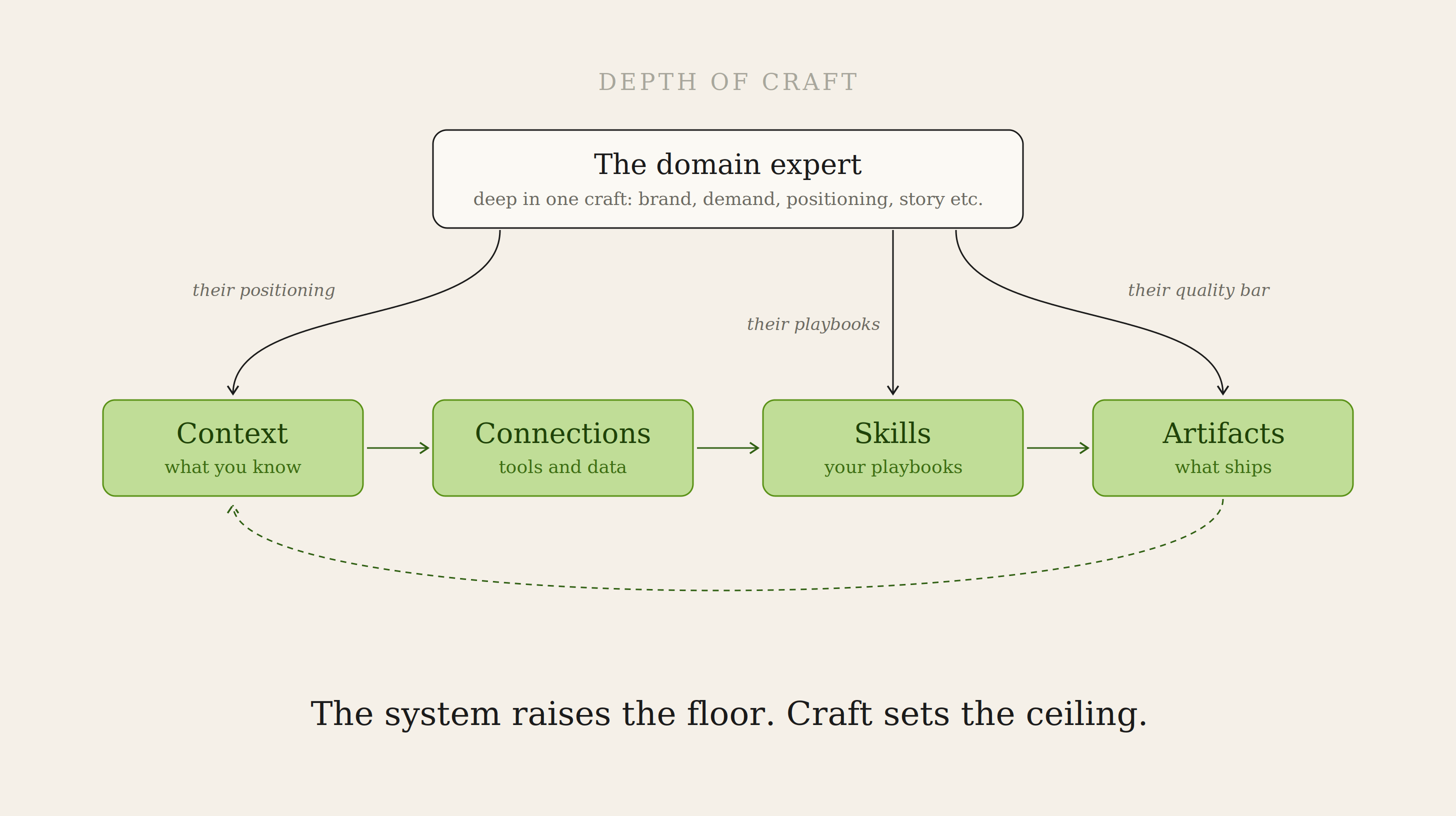
Production is now free. Work that stands out is scarce, and it comes from people who are deep in their craft.
What I’d tell a marketing leader
Build your own v1 first. You can’t redesign a team around a way of working you haven’t tried.
Run 1 pod for 6 weeks before you touch the org chart.
Plan to hire for super generalists and depth of craft.
Decide where you need great. Then make sure that expert’s knowledge is written into Context and Skills, so the whole team starts from their level.
And protect the juniors. Entry-level postings are down about 35% since 2023. Deep craft takes years to build, and if nobody gets those years, Principle 3 has no future. This is a hard one to solve.
So is the marketing team shrinking?
I don’t think so. It’s changing shape. It’s combining the 0-1 marketers & their systems, with depth of craft, all run through pods.
Until Next Time,
Happy AI’fying
Kieran